
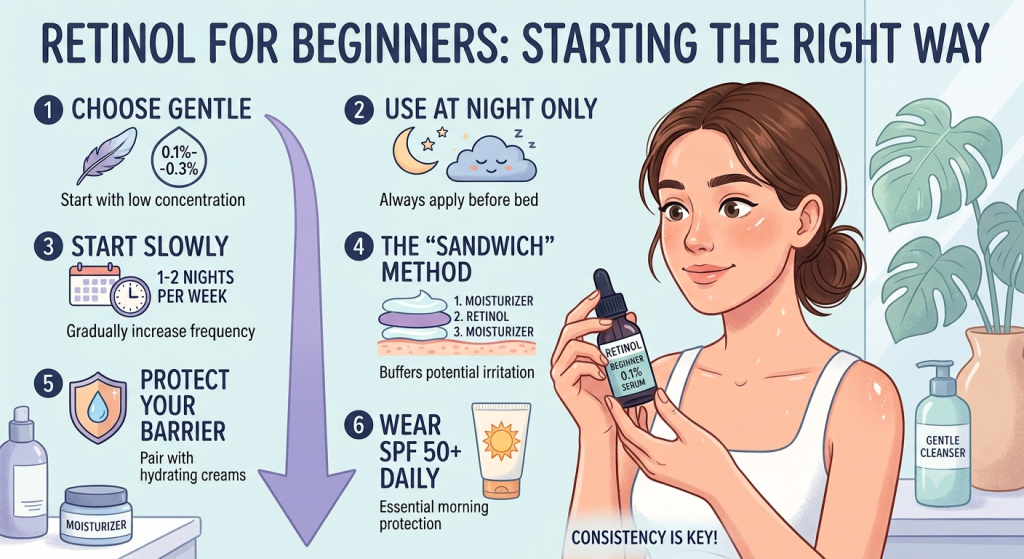
Retinol (a derivative of Vitamin A) is often considered the gold standard in skincare for its unparalleled ability to increase cell turnover and boost collagen production. However, it’s a potent ingredient that requires patience and a proper strategy for those just starting out.
Here is everything you need to know to introduce retinol into your routine successfully.
1. What is Retinol and Why Use It?
Retinol belongs to the retinoid family. It is an antioxidant that speeds up skin cell regeneration and supports collagen synthesis. Consistent, proper use offers impressive benefits:
-
Anti-Aging: Minimizes fine lines and wrinkles.
-
Improves Texture: Smooths rough skin and refines pore appearance.
-
Brightness: Evens out skin tone and fades hyperpigmentation/sun spots.
-
Clarifying: Helps regulate oil and can prevent future breakouts.
2. Why Beginners Must Be Cautious
Retinol is powerful. When you first introduce it, your skin goes through an adjustment period. If you start too strong or apply it too often, it can lead to “Retinol Ugly,” a temporary phase characterized by:
-
Excessive dryness.
-
Flaking and peeling skin.
-
Redness and stinging.
The Golden Rule: The goal is patience, not immediate dramatic results.
3. How to Start: The Step-by-Step Guide
For beginners, minimizing irritation is key. Follow these steps to introduce retinol the right way:
Phase 1: Preparation (1-2 Weeks Before)
-
Simplify Your Routine: Temporarily stop using other harsh exfoliants like BHAs (Salicylic Acid) or AHAs (Glycolic Acid).
-
Fortify Your Skin Barrier: Focus on a strong moisturizer with ceramides to prepare your skin.
Phase 2: Introduction (The First Month)
-
Use it Only at Night: Retinol degrades in sunlight, making it less effective (though it does not make skin phototoxic, it can make it temporarily more sensitive to the sun).
-
Start LOW Strength: Look for products specifically labeled for beginners, often containing 0.1% to 0.3% retinol. You can also start with an ester, such as Granactive Retinoid (Hydroxypinacolone Retinoate), which is known to be gentler.
-
Start SLOW Frequency: Begin by applying a pea-sized amount just one or two nights a week. Gradually increase (e.g., to three nights a week after 3-4 weeks) only if your skin is tolerating it.
-
The “Sandwich” Method: This is the best technique for minimizing irritation. Apply your moisturizer, then a thin layer of retinol, then another layer of moisturizer. This buffers the absorption speed without making the ingredient useless.
4. Critical Rules for Success
-
Sunscreen is Mandatory: Retinol encourages faster cell turnover, revealing new skin that is highly sensitive to UV damage. You must wear broad-spectrum SPF 30 or higher every single day, even when it’s cloudy.
-
Keep Your Skin Hydrated: Use a gentle, hydrating cleanser and a rich moisturizer. Barrier repair creams containing niacinamide or hyaluronic acid are excellent choices.
-
Avoid Irritating Mixes: Never use retinol in the same routine (at the same time) as Vitamin C (which usually requires a specific pH) or intense chemical exfoliants.
5. What to Expect and When to Seek Help
-
Purging: Sometimes, the accelerated cell turnover can cause acne that was dormant to surface faster. This is normal but should resolve within a few weeks.
-
When to Stop: Mild flaking is expected. However, if you experience persistent burning, intense redness, raw patches, or painful inflammation, stop using the product immediately and switch to focusing on barrier repair (with bland, hydrating products).
The Bottom Line
Retinol is a marathon, not a sprint. Consistency is far more important than intensity. Start slowly, protect your skin barrier, wear sunscreen diligently, and you can expect to see noticeable improvements in 3 to 6 months.